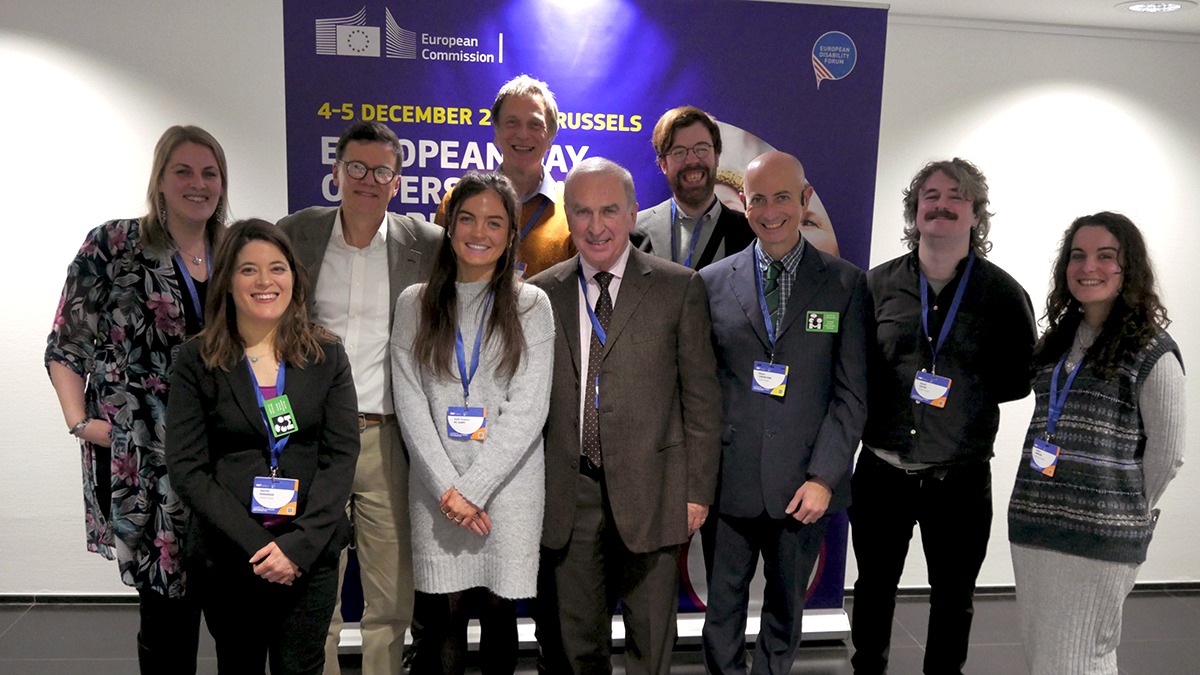
On 4 and 5 December 2025, the European Commission together with the European Disability Forum (EDF) hosted the European Day of Persons with Disabilities (EDPD) 2025, a flagship event bringing together hundreds of European policymakers, disability organisations, advocates, and experts to advance a more inclusive Europe Union. Autism-Europe (AE) was represented by a delegation raising key community issues on independent living and crisis preparedness for autistic people welcoming the Commission’s continued commitment to the rights of people with disabilities in the European Union.
The European Day of Persons with Disabilities 2025 opened on 4 December with strong political commitment, as Hadja Lahbib, European Commission for Equality, Preparedness and Crisis Management from Belgium, highlighted the International Day of Persons with Disabilities on 3 December and reaffirmed the EU’s dedication to the 2021–2030 Disability Rights Strategy, including the proposed €3.6 billion Agora EU programme. Outgoing EDF President Ioannis Vardakastanis praised the impact of the collective action of the disability community over the years. However, he warned that proposed cuts to social funds in the next EU budget risk affect the disability community, while calling for a clear signal of support from the European Commission.
Discussing the next phase of the European Strategy for the Rights of Persons with Disabilities
The first panel discussed how to translate the next phase of the Strategy for the Rights of Persons with Disabilities 2021-2030 into tangible improvements regarding accessibility, independent living, and equal participation of persons with disabilities in the European Union. Markus Schefer, disability expert with the United Nations Convention for the Rights of Persons with Disabilities (UNCRPD) monitoring committee, highlighted the “administrative hurdles” faced by persons with disabilities in exercising freedom of movement in the EU, due to non-portability of benefits and lack of mutual recognition of disability status. An issue that is indeed critical for autistic people given wide variations in access to autism diagnosis and disability recognition across EU Member States. Autism-Europe Council of Administration Member Ettore Foccardi called on the EU to act decisively, as he warned that without dedicated funding to support deinstitutionalisation and staff training, especially for autistic people with high support needs, segregation will persist, underscoring the need for individualised independent living plans.
Example of meaningful use of European funds to support autistic people and their families
The second panel discussed how to make the next EU long-term budget funding disability-inclusive, highlighting how EU financial instruments are crucial to achieving the goals of the Strategy of the Rights of Persons with Disabilities 2021-2030. One example presented is the Cyprus Family Intervention and Support Centre, funded through the European Social Fund+ (ESF+) by 95 per cent until 2027. The centre delivers innovative, individualised home- and community-based support, demonstrating that targeted EU aid can provide holistic, life-changing assistance. A video testimonial from a mother of an autistic child emphasised the centre’s impact, saying it showed her she was not left alone. Maria Toumazou, social policy attaché at Cyprus’ EU permanent representation in Brussels, noted that the centre comes with her country’s first separate National Strategy and Action Plan for Autism. It was approved in April 2024 and covers the entire lifespan, providing tailored interventions for autistic people, complementing Cyprus’s broader National Disability Strategy.
Franck Conrad from the European Commission’s Directorate-General Budget explained that anchoring the European Charter of Fundamental Rights as a horizontal condition in the next EU budget expands coverage and ensures stricter application. This ensures potential funding suspension with incentives for EU Member States to comply, making the system not just punitive but encouraging. Thomas Bignal, Secretary General of the European Association of Service Providers for People with Disabilities, cautioned that simplifying or sidelining the UNCRPD risks misunderstanding its purpose: rather than bureaucracy, it empowers effective use of public funds to benefit people with disabilities.
Zaragoza, Spain, won the 2026 Access City Award
On the second day, 5 December 2025, urban accessibility for people with disabilities took centre stage as the city of Zaragoza, Spain, was awarded the Access City Award 2026 for its investments, legislation, and long-term planning, which include clear standards for streets, transport, public buildings, and services. València, which won second place for its strong leadership and meaningful collaboration with people with disabilities when making buses and metro fully accessible, ensuring 96% of streets and public spaces are barrier-free, and providing digital tools guiding drivers to accessible parking to support independent travel, also received a special mention for accessibility in emergency preparedness.
Preparedness and crisis management
The last panel was precisely dedicated to preparedness and crisis management. It prompted Autism-Europe Council of Administration member Pietro Cirrincione to highlight important gaps across the EU when it comes to autism-friendly emergency management. In this final panel, Ruslan Topchan, a Ukrainian veteran, highlighted rehabilitation challenges in Ukraine, including limited accessible shelters, inclusive warning systems, community-based care, and medical access, stressing that “Inclusiveness is not a privilege; it is a necessary condition for saving lives.” Hans Das from the European Commission’s Directorate-General for European Civil Protection and Humanitarian Aid Operations, reaffirmed the EU’s commitment that “Crisis preparedness is for everyone,” noting the development of guidelines incorporating disability needs into emergency services and training. Autism-Europe welcomes this focus and urges collaboration with autistic people and other disability communities to ensure all emergency plans are inclusive, pointing to existing good practices such as Catalonia’s regional programme adapting civil protection messages with the autistic community.
More information here