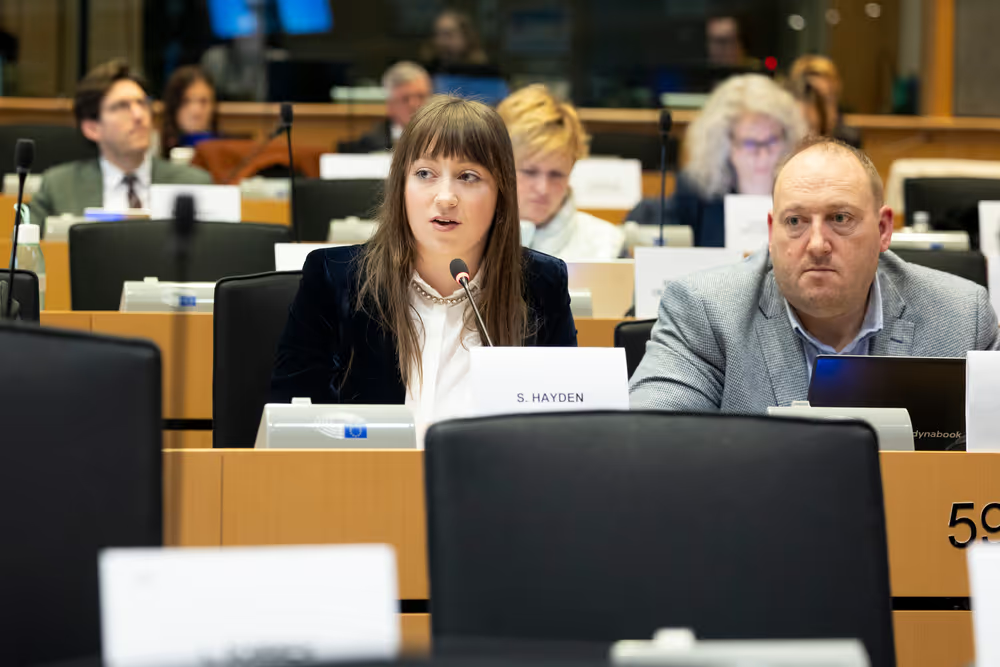
Sarah Hayden, a 20-year-old autistic student of International Relations and Politics from Ireland, is an intern at AsIAm and a young self-advocate. Representing Autism-Europe, she recently shared her experience as a young autistic woman at a public hearing of the European Parliament’s EMPL Committee during the Disability Week, held in the context of the European Day of Persons with Disabilities on December 3rd.Sarah Hayden outlined the systemic and personal barriers autistic people face across education, employment, and community life.
In her contribution, Sarah discussed how autistic people are affected by societal barriers and misunderstandings of autism. Explaining further, she outlines that invisible barriers sync as rigid social norms, inaccessible recruitment process, sensory challenges, differences in communication styles and the intense pressure to mask all contribute to the inaccessibility of the whole of society. Sarah identified that the cause of this inaccessibility, that many environments were designed without autistic people in mind.
Highlighting to the committee that every autistic person is unique. That they each have their own needs, wants and goals in life. Because of this diversity, each autistic person should be encouraged to use their own structures and systems, and live their lives as they want to and in their own way. Society discourages autistic people from living their authentic self by marginalising autistic traits. For Sarah, this has meant that entering employment is a specific problem. As a 16-year-old, Sarah was attempting to find a part-time job, but no matter how many applications she submitted, how many times she checked her CV and prepared herself for interviews, she was unsuccessful in her job search. Despite at numerous times making it to the interview stage, she was rejected as she was “too honest”. Simply put, she found finding a job difficult because she did not fit in with societal expectations. Sarah, like many autistic people, finds that the hidden social rules and expectations of the workplace make it difficult for autistic people to thrive.
The importance of accommodations
Sarah discussed the importance of workplace accommodations, where a greater degree of respect for autistic people’s sensory sensitivities could be effective in reducing the accessibility barriers associated with work. She emphasised that with clear communication, predictability, and reasonable adjustments, autistic people can thrive in workplaces that adapt to their needs.
The speech demonstrates how autistic people encounter barriers in education and employment impacts autistic people’s ability to fully participate in society. Hayden explains that true inclusion is about belonging, integration, and support, not just simply a physical presence. The pressure to suppress autistic traits and the lack of accessible environments can limit confidence, self-advocacy, and community engagement, reducing opportunities for autistic people to contribute meaningfully to civic and social life. Sarah challenged the committee’s mindset of autism, advocating for a neuro-affirmative approach.
Barriers to Work Begin in the Classroom, Not the Job Market
Barriers to accessing the workplace do not begin with a job application. They begin much earlier, in the classroom. While autistic children may have a legal right to education, advocates argue that this right is often hollow unless education systems are equipped to meet individual needs. Inclusion, they say, must mean more than physical presence. It must involve belonging, meaningful integration, and sustained support.
Public debate frequently centres on equality of opportunity, yet far less attention is paid to equality of outcome. Without a genuinely inclusive education system, one that allows all children to learn alongside one another, systemic barriers will persist, shaping life chances long before adulthood.
Many autistic people feel that school is not a place of empowerment but of quiet erasure. Darah recalls being urged to be “more normal,” reprimanded for reading during breaks instead of socialising, and discouraged from asking for help. These early lessons to stay silent and suppress differences often carry into adult life, even when legal rights to accommodation exist. Sarah’s experience is reflected in AsIAm’s Same Chance report, where 70 per cent of autistic adults do not access any supports or accommodations in the workplace.
Autism is frequently described as an invisible disability, a label that reflects the pressure many autistic people feel to hide their needs to be accepted. This phenomenon, known as masking, is particularly common among late-diagnosed women. Natural behaviours are suppressed, emotions moderated, and coping mechanisms concealed to fit narrow expectations of what is deemed “professional” or “reliable.”
Sensory differences further complicate workplace participation. Harsh office lighting, for example, can be painful and distracting, while the need for movement, such as pacing, can be essential for concentration. Simple adjustments, like warmer lighting or flexible movement, can dramatically improve productivity. These are not shortcomings, but differences that need not become barriers if appropriate accommodations are in place.
Sarah advised the committee that workplaces and employment laws must evolve to reflect human rights and protect dignity throughout a person’s career. Accommodations must be shaped by individual needs and co-created with autistic and other employees with disabilities.
Creating inclusive workplace cultures benefits everyone, not only autistic and disabled people. Environments where individuals feel safe to be themselves foster wellbeing, creativity, and productivity across the board.
At a policy level, Sarah has called for stronger European legislation on disability rights. Currently, responsibility lies largely with individual member states, resulting in wide disparities. Eurostat figures from 2024 show a 24-percentage-point disability employment gap across the EU, with Ireland at 38.2 points compared to 20.9 in the Netherlands. Sarah argues that such inequalities undermine the principle of equal outcomes and demand a comprehensive, EU-wide approach to disability services and protections.
Sarah closed her intervention with a quote from philosopher Martha Nussbaum, “The measure of a society is how it treats those whose capacities differ from the norm.”