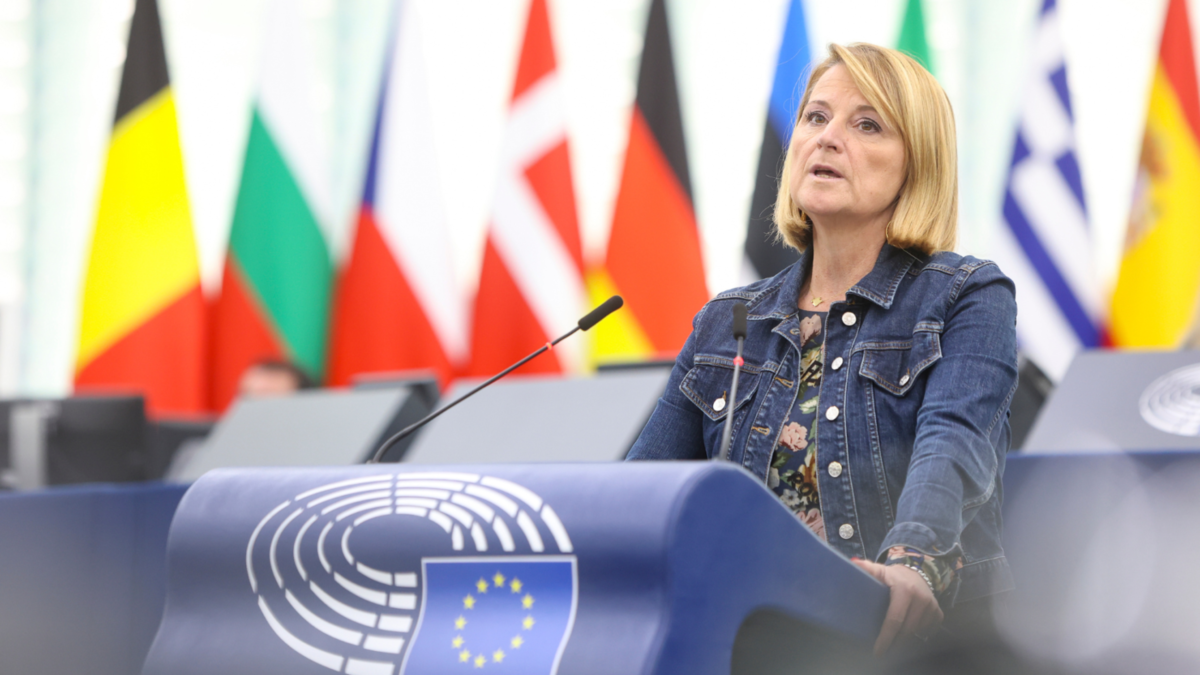
On 27 November 2025, the European Parliament endorsed a report urging the European Commission to introduce new measures beyond 2024 for the European Strategy for the Rights of Persons with Disabilities 2021–2030. The vote saw 409 MEPs in favour, 9 against, and 109 abstentions. Led by Spanish MEP Rosa Estaràs, Vice Chair of the Committee on Women’s Rights and Gender Equality and a long-standing ally of Autism-Europe, the report includes multiple references to autism and autistic people. Autism-Europe welcomes this timely initiative as a strong signal for disability rights across the European Union and beyond.
The report presented by MEP Estaràs on the EU strategy for the rights of persons with disabilities beyond 2024 urges the European Commission to review and update the strategy, considering the main challenges faced by people with disabilities. The report calls for improved accessibility, transforming AccessibleEU into a permanent agency, and ensuring that persons with disabilities can fully enjoy their EU rights, live independently with a decent quality of life, have equal access to all service (noting that the current European Disability Card will not guarantee mutual recognition of disability status when establishing in a different EU country), and be protected against discrimination.
The report also emphasises support for families and carers, raising awareness, and introducing an EU-wide definition of disability to guarantee equal rights for all EU citizens with disabilities. MEPs propose an EU-funded employment and skills guarantee, along with measures to improve access to training and education. Particular attention is given to women and girls with disabilities, highlighting the need to combat discrimination and improve their access to healthcare, participation, and protection.
Autism-Europe welcomes the recommendations of the report as well as the reference to the 2023 European Parliament resolution on harmonising the rights of autistic people. The report also stresses that autistic people face one of the highest unemployment rates in Europe, around 90%. Therefore, it calls for autism-specific employment programmes to ensure positive action recruitment and create tangible job opportunities.
It also urges the European Commission and EU Member States to take steps to harmonise and expedite the recognition of autism, among others, guaranteeing access to social protection mechanisms, assistive technologies, personal assistance, and care where appropriate, without administrative delays. Furthermore, the report calls for support in developing EU-wide accessibility standards, including adjustable lighting, quiet zones, screen-filtering tools, and remote participation options.
Presentation of the report during a plenary debate at the European Parliament
The report was at the heart of an hour long European Parliament plenary debate in Strasbourg, France, on the evening of 26 November 2025, where a European Commissioner and several MEPs addressed the hemicycle on key issues, including awareness, social inclusion, accessibility, antidiscrimination, care, education, employment, independent living and housing for people with disabilities of all ages and their families.
Roxana Mînzatu, European Commissioner for Social Rights and Skills, Quality Jobs and Preparedness, highlighted key achievements of the Strategy for the Rights of Persons with Disabilities 2021-2030. She stressed that disability rights touch every aspect of life for persons with disabilities and their families, and referred to next steps: integrating recommendations of the independent committee for the rights of Persons with disabilities overseeing the UNCRPD, gathering input via a public consultation (open until 6 February 2025), and presenting an enhanced strategy in spring 2026.
The barriers faced by autistic people and their families were also called out by MEP Estaras, who especially pointed to the disproportionately high unemployment rate of autistic jobseekers and MEP Chiara Gemma from Italy, who lamented the lack of social inclusion of autistic children and their families. 46 other MEPs from 21 European Union (EU) country namely Austria, Belgium, Bulgaria, Croatia, Cyprus, Spain, France, Finland, Germany, Greece, Hungary, Italy, Ireland, Lithuania, Luxemburg, Malta, Netherlands, Poland, Portugal, Romania and Slovenia from all political groups and non-attached took the floor to raise issues related to employment and economic inclusion, education and social inclusion, accessibility and housing, digital transformation and technology, gender based-violence in relation to people with disabilities and families and carers.
In her closing remarks, Mînzatu outlined future priorities for the European Commission, among them universal accessibility, artificial intelligence and assistive technologies, research, and links to quality jobs and affordable housing. She promised a strong partnership with the European Parliament, jointly with Hadja Lahbib, European Commissioner for Equality, Preparedness and Crisis Management, to deliver a “social Europe” based on equality, autonomy, and dignity for all.
- Find the report here.
- Read the verbatim report of the debate here.
- Watch the debate here (in all 24 EU languages).
Why the report and ensuing debate?
In March 2021, the European Commission adopted a 2021-2030 strategy for the rights of persons with disabilities, including AccessibleEU and the European Disability Card. The Strategy for the Rights of Persons with Disabilities 2021-2030 comprised programmes and flagship initiatives until 2025. With the report adopted today, the European Parliament is proposing new initiatives for the period 2026-2030. The European Commission has already announced it will propose new actions for this Strategy in 2026 – in line with our longstanding calls.