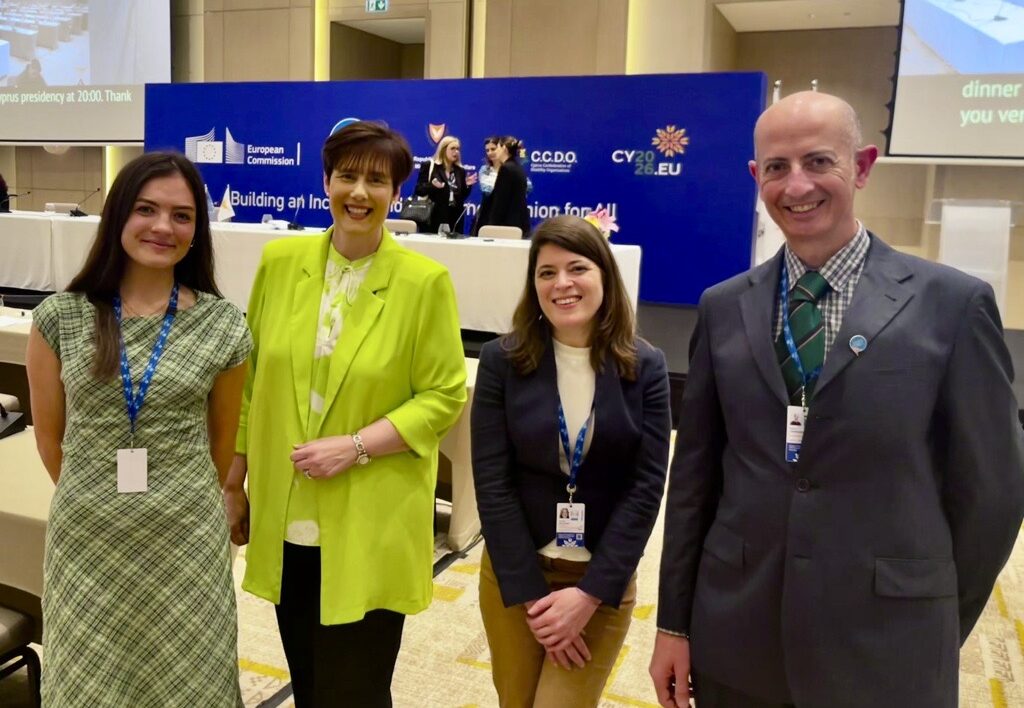
Autism-Europe attended the High-Level Conference on “Inclusion of Persons with Disabilities: Empowerment and Support in a Community for All”, organised by the Cyprus Presidency of the Council of the EU 2026 in Limassol on 7 May 2026. The conference brought together representatives of EU institutions, governments, organisations of persons with disabilities, service providers and self-advocates to discuss the transition from substitute decision-making systems towards rights-based, supported decision-making in line with the UN Convention on the Rights of Persons with Disabilities (CRPD).
Throughout the day, participants repeatedly stressed that legal capacity and self-determination are fundamental human rights. “Supported decision-making is not optional, it is the bridge between rights on paper and rights in real life,” said Themida Anthopoulou, Chairperson of the Cyprus Confederation of Disability Organisations. “The problem was never the person, it is the system”.
Strong calls for Rights-based Reform
The opening session featured interventions from senior representatives of the European Commission, the European Disability Forum and the Cypriot government. Commissioner for Equality, Preparedness and Crisis Management, Hadja Lahbib emphasised the importance of community living, inclusion and independent decision-making as central principles of the EU strategy for the rights of persons with disabilities. Speakers also highlighted concerns regarding insufficient funding and the need for stronger legislative action at EU level to ensure the full implementation of the CRPD.
The overarching focus of the conference was Article 12 of the CRPD, which recognises the right of persons with disabilities to enjoy legal capacity on an equal basis with others. Experts and advocates stressed that denying legal capacity often results in institutionalisation, exclusion from civic participation and increased vulnerability to abuse or exploitation.
National Reforms and Practical Approaches
The first panel explored reforms and practical approaches to supported decision-making across Europe. Representatives from Spain, Ireland, Malta and Cyprus shared experiences of legislative reform and the development of national supported-decision making services aimed at replacing guardianship regimes.
One recent example being the implementation of Irelands legislative reform found under the Assisted Decision-Making (Capacity) Act, which is based on principles such as the presumption of capacity, respect for will and preferences, and minimal restriction of rights. Speakers noted that implementing supported decision-making in practice requires sustained investment, training and cultural change, including support for families and professionals adapting to new models.
The Cypriot authorities presented their ongoing efforts to reform their own legal framework and develop a nationwide supported decision-making system. Cyprus has already launched an ESF+-funded pilot project employing supported decision-making advisors and recently adopted new legislation on social participation, inclusion and independent living for persons with disabilities. However, speakers acknowledged that further work remains necessary to fully replace guardianship laws and establish robust monitoring mechanisms.
Discussions also highlighted concerns regarding the continued reliance on mental capacity assessments and involuntary treatment in many European legal systems, particularly affecting persons with psychosocial and intellectual disabilities. Several speakers warned that international instruments such as the Hague Convention on the Protection of Vulnerable Adults risk reinforcing substitute decision-making approaches that are not fully aligned with the CRPD.
Building Inclusive Community-Based Support Systems
Another key topic throughout the conference was the importance of personalised, community-based support services. Speakers stressed that supported decision-making cannot function in isolation: accessible communication, independent living services, personal assistance, peer support and inclusive employment opportunities are all essential to ensuring meaningful autonomy and participation in society.
Autistic-led Social Enterprise
One of the most inspiring moments of the conference was a presentation by Voice for Autism, a Cypriot organisation, about the country’s first social enterprise, which is run by autistic people— from the baristas to the shareholders. The initiative demonstrated how inclusive entrepreneurship can create pathways to employment, independence and community participation for autistic people while challenging traditional segregated employment models.
The social enterprise currently employs autistic staff members in an inclusive business environment located in central Nicosia. Five autistic people are shareholders in the enterprise itself, making it a particularly innovative model of ownership and participation. Organisers explained that the project was developed through cooperation between civil society, government and private sector actors, with support from the Cypriot Department of Social Inclusion for Persons with Disabilities.
Presenters also highlighted the broader social impact of the initiative. Beyond employment, the model provides ongoing coaching, life-skills development and opportunities for greater social inclusion. At a time when disability employment gaps remain high across Europe, the project illustrated how social enterprises can support de-institutionalisation and create genuine alternatives to sheltered workshops.
The presentation also shed light on the challenges faced by disability-led social enterprises, including legal uncertainty, lack of regulatory recognition and difficulties accessing sustainable funding. Nevertheless, the project offered a strong example of how inclusive, community-based approaches can empower autistic people and promote equal participation in economic and social life.
Planning for the next EU Council Presidency
Alongside the conference, Autism-Europe was pleased to meet with Ireland’s Minister for Children, Disability and Equality, Norma Foley, ahead of the upcoming Irish Presidency of the Council of the EU. The exchange provided an opportunity to discuss shared priorities regarding disability inclusion, legal capacity, independent living and the rights of autistic people across Europe.
This meeting was part of our ongoing dialogue with the rotating Presidencies of the Council of the EU.
Reflections on the Conference
The conference in Limassol demonstrated both the growing momentum behind supported decision-making reforms in Europe and the significant work still required to ensure the full implementation of the CRPD. Discussions repeatedly reinforced that inclusion requires practical, accessible and adequately funded support systems that respect the autonomy, dignity and preferences of persons with disabilities.
For Autism-Europe, the event also reaffirmed the importance of ensuring that autistic people, including those with intellectual disabilities and higher support needs, are fully included in reforms relating to legal capacity, independent living and community participation.