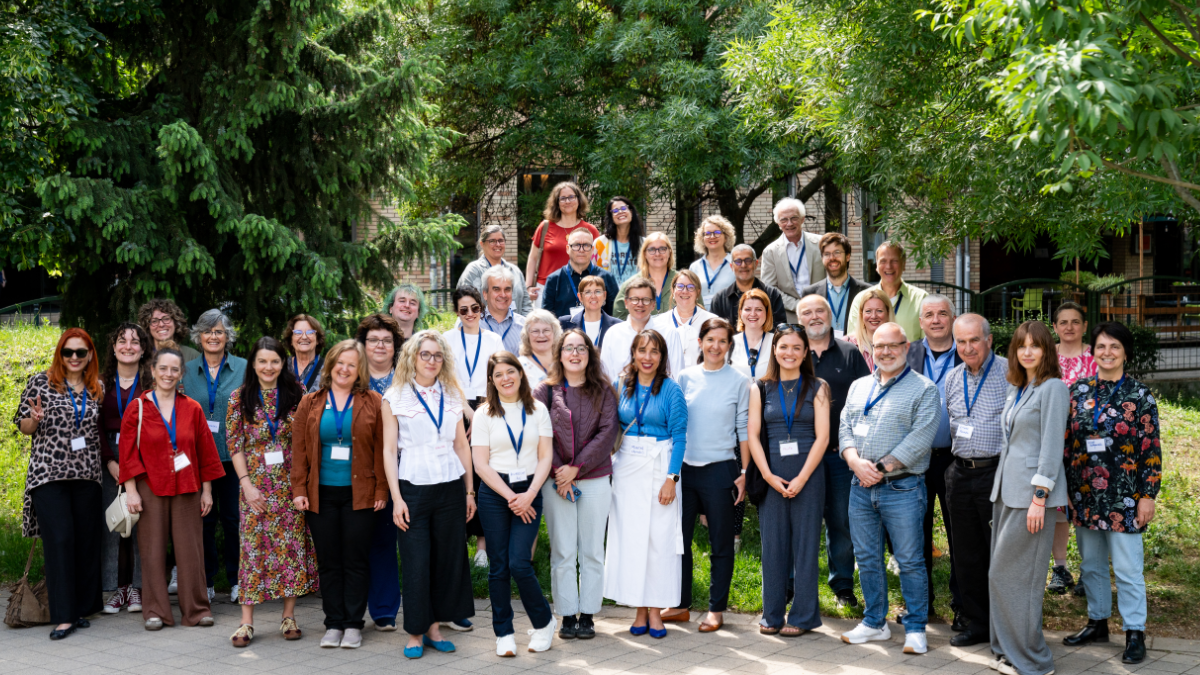
Autism-Europe held its Annual General Assembly (AGA) and Council of Administration (CA) on 9–10 May 2026 in Budapest, Hungary. The meetings brought together members from across Europe, both in person and online, to reflect on ongoing work and look ahead to the organisation’s future priorities.
Some of the key moments included discussions on AE’s 2026 work programme, progress on a major guidance publication on autism, and strategic exchanges on future initiatives, including EU-funded projects and policy priorities.
Looking back, planning ahead
On Saturday (9 May), around 65 participants took part in the AGA, where they reviewed AE’s activities and priorities. AE director Aurelie Baranger presented a report on the activities completed in 2025. Members then discussed the 2026 work programme, which sets out continued efforts to engage with EU institutions, in particular regarding the implementation of the next stage of the EU strategy on the rights of persons with disabilities. Members also heard updates on awareness-raising work, including the “Not invisible” campaign, as well as AE’s involvement in EU-funded projects benefitting autistic people and their families.
AE plans to create country-by-country reports to assess autistic people’s access to education and community support systems, healthcare and social protection. This will serve to inform decision-makers and the wider public. In an afternoon session, members discussed the methodology and potential issues of such a Europe-wide analysis.
The Compass project — an EU-funded initiative in which both AE and Hungarian member Mars Foundation are project partners — presented its work in training autistic people and their families to become advocates, in particular vis-à-vis legal systems and services.
Toward the end of the day, AE voted on membership applications from three organisations, all of which were accepted. These new associated members are Agios Vasileios Stevros and the
Hellenic Association for Asperger Syndrome (ΕΛΣΣΑ), both from Greece, as well as Djeca Svetlosti from Bosnia and Herzegovina.
Members also voted on a new council of administration for Autism-Europe. You can find details about the council members here.
As always, the AGA also gave members the chance to exchange updates, share experiences, and strengthen cooperation across the network.
Advancing key initiatives
On Sunday (10 May), the CA continued the discussions, focusing on several strategic topics.
One of the central presentations of the day was on the updated edition of Autism-Europe’s guide People with Autism Spectrum Disorder: Identification, Understanding, Intervention. This publication aims to bring together the latest research and offer an evidence‑based, rights‑based approach that supports families and professionals, in line with the UN Convention on the Rights of Persons with Disabilities. Members were updated on the progress made by an international team of experts—including autistic contributors—and on the ongoing consultation process with the autism community to ensure the guide is both accessible and relevant.
Members also discussed the next steps in appointing members to a scientific and ethics advisory committee, looking at ways to ensure strong expertise—and full representation of autistic people with different support needs—in this area.
Looking ahead, the Council began early discussions on the 2027 work programme. Members also explored potential partnerships, including a cooperation opportunity on housing with Fondation Autisme Luxembourg, and exchanged knowledge on autism and ageing by sharing existing resources and experiences.
Participants also received a short update on preparations for Autism-Europe’s International Congress 2028, as work continues on this major event.
Autism-Europe warmly thanks all members who took part in the meetings in Budapest and online and wants to especially thank the Mars Foundation for a warm welcome and meticulous planning of this year’s edition of the assembly.